A Perfect Storm – Trade Finance Compliance at a Turning Point
Interview with IBS Intelligence

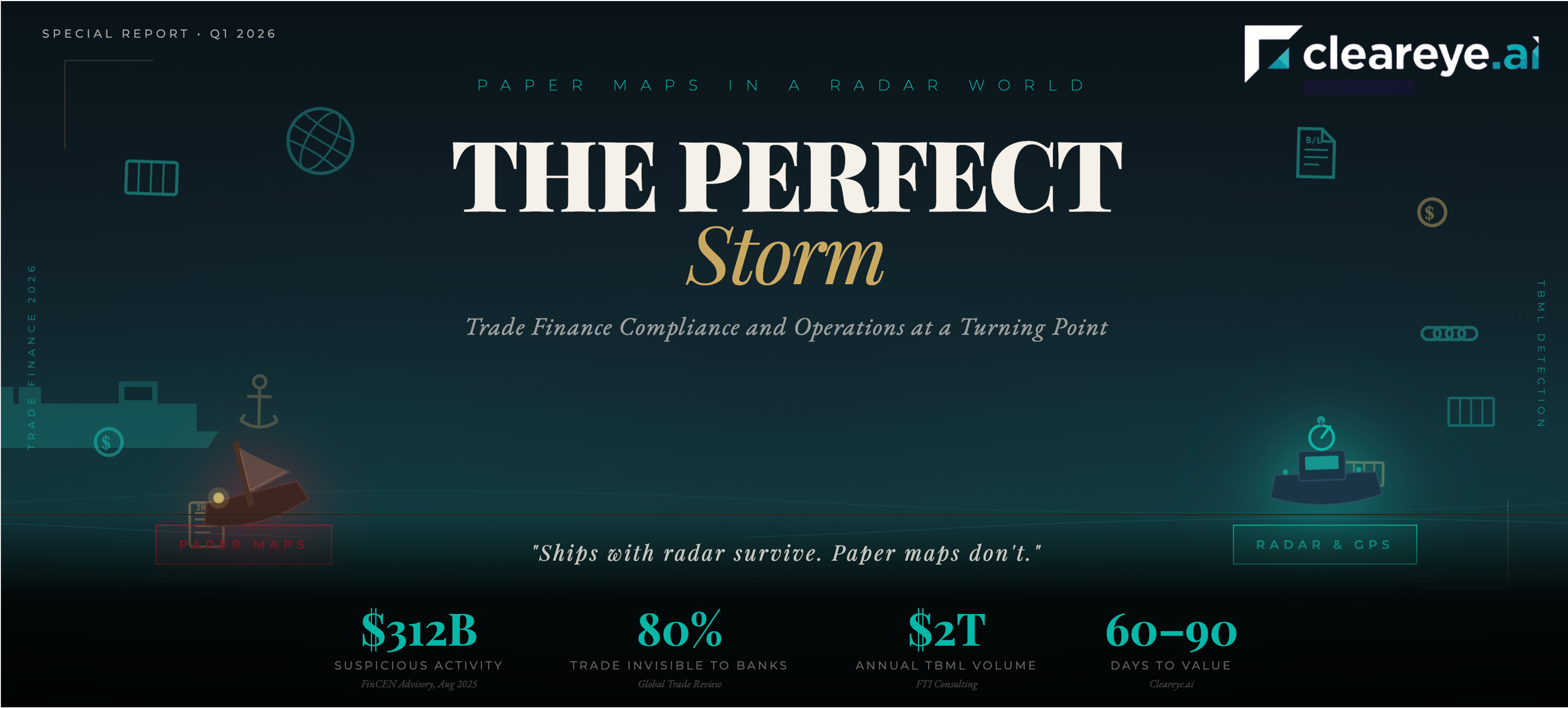
Trade-based money laundering is how criminals move dirty money across borders disguised as legitimate trade. Banks are spending millions but are still missing most suspicious activities, in part because 80% of global trade operates on open account terms with minimal documentation.
So, what can be done?
"80% of global trade operates on open account terms with minimal documentation — that's the challenge banks face in detecting trade-based money laundering."
Read Transcript
Robin Amlôt: Welcome to IBS Intelligence. Today we're discussing trade finance compliance with Anar Qasem, Vice President of MENA at Cleareye.ai. Anar, trade-based money laundering has been called "the perfect storm" for compliance teams. Can you explain why?
Anar Qasem: Absolutely, Robin. Trade-based money laundering, or TBML, is how criminals move dirty money across borders disguised as legitimate trade. What makes it a perfect storm is the combination of massive volume — global trade is worth trillions annually — and the complexity of documentation. Banks are spending millions on compliance but are still missing most suspicious activities.
Robin Amlôt: Why is it so difficult for banks to detect these suspicious activities?
Anar Qasem: The main challenge is that 80% of global trade now operates on open account terms with minimal documentation. Unlike traditional letters of credit where banks see detailed trade documents, open account trade often means banks only see payment instructions. They're essentially flying blind.
Robin Amlôt: So what can be done? How does AI help address this challenge?
Anar Qasem: AI and machine learning can analyze patterns across thousands of transactions simultaneously. We can identify anomalies that would be impossible for human analysts to spot — pricing irregularities, suspicious trade routes, unusual counterparty relationships. The technology learns from known TBML patterns and can flag high-risk transactions for further review.
Robin Amlôt: What does the path forward look like for the industry?
Anar Qasem: We need a combination of advanced technology, better data sharing between institutions, and regulatory clarity. No single bank can solve this alone. The criminals are sophisticated and international, so our response needs to be equally coordinated. AI gives us the tools, but we also need the frameworks for collaboration.
In this interview with Robin Amlôt of IBS Intelligence, I discuss the challenges banks face in detecting trade-based money laundering and how AI-powered solutions can help identify suspicious patterns that traditional methods miss.
Key topics covered:
The Scale of the Problem: Trade-based money laundering represents one of the largest channels for illicit financial flows globally, with estimates suggesting it could account for hundreds of billions of dollars annually.
Why Traditional Methods Fall Short: Banks are investing heavily in compliance, but manual document review and rule-based systems struggle to detect sophisticated TBML schemes, especially in open account trade where documentation is minimal.
The AI Advantage: Machine learning models can analyze patterns across thousands of transactions, identifying anomalies that would be impossible for human analysts to spot — from pricing irregularities to suspicious trade routes and counterparty relationships.
The Path Forward: A combination of advanced technology, better data sharing between institutions, and regulatory clarity will be essential to turning the tide against trade-based money laundering.