Interview with IBS Intelligence

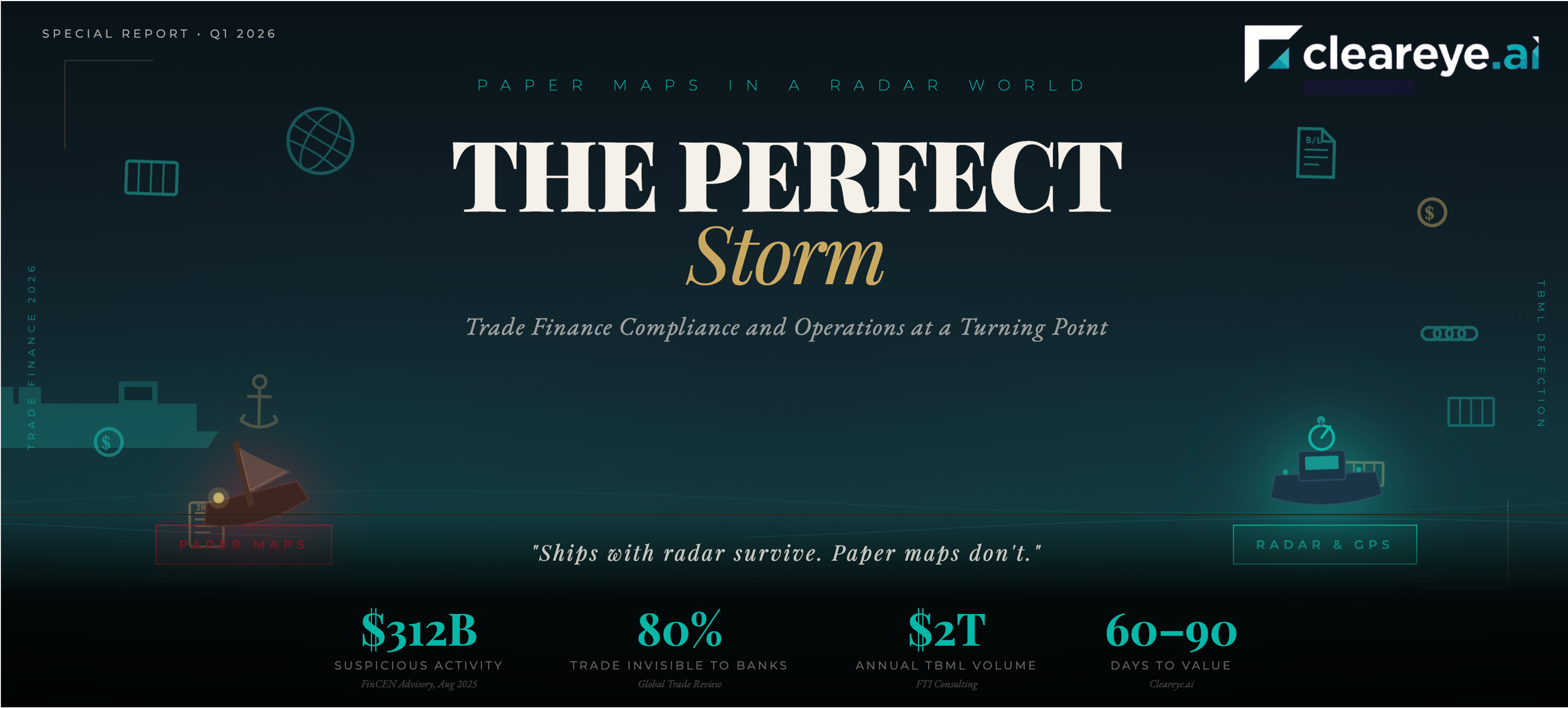
Trade-based money laundering is how criminals move dirty money across borders disguised as legitimate trade. Banks are spending millions but are still missing most suspicious activities, in part because 80% of global trade operates on open account terms with minimal documentation.
So, what can be done?
Read Transcript
Robin Amlôt: Welcome to IBS Intelligence. Today we're discussing trade-based money laundering with Anar Qasem, Vice President of MENA at Cleareye.ai. Anar, can you tell us about the scale of this problem?
Anar Qasem: Thanks Robin. Trade-based money laundering is one of the most significant challenges facing banks today. We're talking about an estimated $2 trillion in illicit funds flowing through global trade each year. The problem is that 80% of global trade operates on open account terms with minimal documentation, making it incredibly difficult for banks to detect suspicious activity.
Robin Amlôt: So banks are spending millions on compliance but still missing most suspicious activities?
Anar Qasem: Exactly. Traditional methods rely heavily on manual document review and rule-based systems. But sophisticated criminals know how to structure transactions to avoid triggering these rules. They use techniques like over-invoicing, under-invoicing, multiple invoicing, and phantom shipments. Without the ability to see patterns across thousands of transactions, banks are essentially looking for needles in haystacks.
Robin Amlôt: How can AI help solve this problem?
Anar Qasem: AI and machine learning can analyze vast amounts of trade data to identify anomalies that would be impossible for human analysts to spot. We're talking about analyzing pricing patterns across commodities, detecting unusual trade routes, identifying suspicious counterparty relationships, and flagging transactions that deviate from normal patterns. The technology doesn't replace human judgment—it augments it by surfacing the highest-risk transactions for review.
Robin Amlôt: What's the path forward for banks in the MENA region?
Anar Qasem: Banks need to embrace technology, but they also need to think about data sharing and collaboration. No single bank has visibility into the full picture. We need better information sharing between institutions, clearer regulatory guidance, and continued investment in advanced analytics. The banks that get this right will not only reduce their compliance risk but also gain competitive advantage through faster, more confident trade finance decisions.
"80% of global trade operates on open account terms with minimal documentation — that's the challenge banks face in detecting trade-based money laundering."
In this interview with Robin Amlôt of IBS Intelligence, I discuss the challenges banks face and how AI-powered solutions can help detect suspicious patterns that traditional methods miss.